
Prepaid Electricity Bands (Band A–E): What ₦10,000 of Units Buys in 2026
About 13 min readVerified 12 October 2026
Verification status: Manually reviewed guidance. Figures were last verified against the named official source on 12 October 2026; official requirements and fees can change, so check the linked agency before payment.
Your NERC service band sets how many hours of supply your feeder should give you, and your DisCo sets what you pay for each unit (kWh). Neither number is national: NERC approves a separate rate for each DisCo, every month.
Band A means NERC's service promise of a minimum of 20 hours of supply a day. Band B is 16 hours, Band C 12, Band D 8 and Band E 4. That is the definition NERC publishes in its own electricity tariff FAQ, and it is the reason Band A costs the most per unit.
What complicates everything is that your rate is not national. NERC issues a supplementary order for each DisCo every month, and each order carries its own table. We read two of them — Eko (EKEDP) and Benin (BEDC), both effective 1 September 2026 — and the two tables already disagree on Bands B to E. This page reflects what we verified on 12 October 2026 and is not an automatically updated feed.
This guide gives you the official steps, the documents, the cost picture and the mistakes to avoid. Figures were last verified against the named official sources on 12 October 2026. Always confirm on the official site before you pay.
Quick take
- Band A promises a minimum of 20 hours of supply a day; Band B 16, Band C 12, Band D 8 and Band E 4. That is NERC's own definition.
- Your rate is per DisCo, not national. The two September 2026 orders we read agree on Band A at ₦209.50 per kWh and disagree on Bands B to E.
- At that Band A rate, ₦10,000 is roughly 48 units before VAT and fixed charges. On Band B it is roughly 164 units.
- Work out your own rate from a receipt: amount divided by units, less VAT. NERC says so itself.
- Nobody can sell you a band upgrade, and nobody should sell you a meter outside the DisCo or approved-vendor process.
- Fee: No single national rate — NERC approves rates per DisCo and per band. In the two September 2026 orders we read, Band A sits at ₦209.50 per kWh for both Eko (EKEDP) and Benin (BEDC), while Band B is ₦61.00 for Eko and ₦68.56 for Benin.
- Timeline: Rates are re-set monthly through NERC supplementary orders, so they can move with little notice. NERC requires your DisCo to tell you about rate reviews on your bill or through its other channels.
- Official site: https://nerc.gov.ng
Where these figures come from
Last verified: 12 October 2026Manually verified against the official source
Band definitions, the 60-day failure review and the receipt method are from NERC's own Electricity Tariffs FAQ. The naira-per-kWh rows are read directly from two NERC September 2026 supplementary orders — Order/NERC/2026/091 for Eko Electricity Distribution Plc and Order/NERC/2026/089 for Benin Electricity Distribution Company — both effective 1 September 2026. This page is checked by hand and is not an automatically updated feed.
Official portals to check before you pay
Not verified — confirm before you pay
- The current rate for your own DisCo. We verified Eko (EKEDP) and Benin (BEDC) only, and only for the yet-to-be-transitioned states inside each franchise. Open your DisCo's latest supplementary order on nerc.gov.ng.
- Rates in states that have moved to their own state electricity regulator. Those are approved by the state regulator, not by the NERC orders quoted here.
- The fixed monthly service charge, meter maintenance charge and VAT treatment on your specific account. Your vending receipt is the authority.
- Which band your own feeder sits on today. Bands are reviewed monthly and feeders are upgraded and downgraded by NERC order.
Quick answer
Your NERC service band sets how many hours of supply your feeder should give you, and your DisCo sets what you pay for each unit (kWh). Neither number is national: NERC approves a separate rate for each DisCo, every month. Fees: No single national rate — NERC approves rates per DisCo and per band. In the two September 2026 orders we read, Band A sits at ₦209.50 per kWh for both Eko (EKEDP) and Benin (BEDC), while Band B is ₦61.00 for Eko and ₦68.56 for Benin. Timeline: Rates are re-set monthly through NERC supplementary orders, so they can move with little notice. NERC requires your DisCo to tell you about rate reviews on your bill or through its other channels.
What the five service bands actually mean
NERC introduced the Service-Based Tariff to tie what you pay to the service you actually receive. It took effect on 1 November 2020. It groups every feeder into one of five bands, measured by the average hours of supply per day over one month.
Your band is a property of your feeder, not a choice you make, and it can change. NERC reviews feeder performance monthly and issues orders that upgrade or downgrade feeders, so an estate can move in either direction.
The five bands, exactly as NERC states them in its electricity tariff FAQ:
| Band | Minimum hours of supply per day | What that means at home |
|---|---|---|
| Band A | 20 hours | The highest committed service level, and the highest rate per unit. |
| Band B | 16 hours | Most of the day, with gaps. Noticeably cheaper per unit than Band A. |
| Band C | 12 hours | About half the day. Many urban and peri-urban feeders sit here. |
| Band D | 8 hours | Supply in blocks rather than continuously. |
| Band E | 4 hours | The lowest committed service level under the scheme. |
What one unit costs, and why nobody can quote you one national figure
There is no single 'Nigeria electricity tariff'. NERC approves an end-user rate for each DisCo, and the bands below Band A are not uniform across the country either.
The table below is taken from two NERC supplementary orders that took effect on 1 September 2026. Both approve rates for the 'yet to be transitioned states' inside each DisCo's franchise area — Ogun State for Eko (EKEDP), and Edo plus Delta for Benin (BEDC). If you live in a state that has moved its electricity regulation to a state regulator, your rate is approved by that state regulator, not by these orders.
Notice that Band A is the same in both tables and the lower bands are not. That is the clearest illustration of why a friend's unit cost in another state tells you nothing about yours.
Non-MD means customers on a single or three-phase connection, which is what most homes and small shops are. MD customers are on maximum-demand connections and have their own rows in the same orders.
| Customer class | Eko (EKEDP) — Ogun | Benin (BEDC) — Edo and Delta |
|---|---|---|
| Lifeline (R1, up to 50 kWh a month) | ₦4.00 | ₦4.00 |
| Band A — non-MD | ₦209.50 | ₦209.50 |
| Band B — non-MD | ₦61.00 | ₦68.56 |
| Band C — non-MD | ₦48.53 | ₦56.91 |
| Band D — non-MD | ₦32.48 | ₦41.20 |
| Band E — non-MD | ₦32.44 | ₦41.21 |
What ₦10,000 of units actually buys
One unit is one kilowatt-hour (kWh). It is what a 1,000-watt appliance uses in one hour, or what a 100-watt bulb uses in ten hours. To estimate what an appliance costs you, take the watt rating on its nameplate, divide by 1,000, and multiply by the hours you run it.
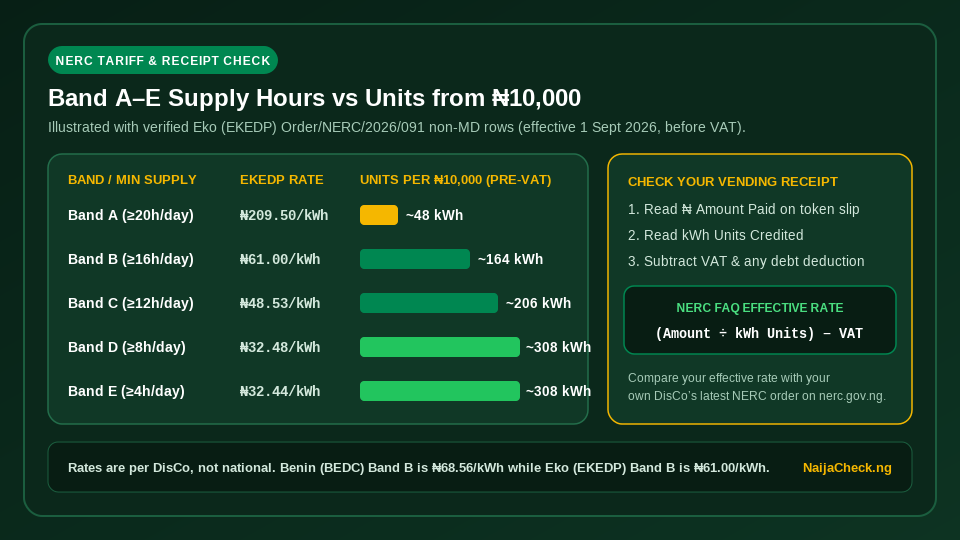
Using the Eko (EKEDP) rows above, here is the straight-line answer to the question people actually ask. Divide ₦10,000 by the rate and you get the units — before VAT and before any fixed monthly charge come off, which is why a real receipt always shows fewer units than this.
Put another way: the same ₦10,000 buys roughly three times more electricity on a Band B feeder than on a Band A feeder, and about six times more on Band E. That gap is the whole argument behind the band system, and it is why the first question to ask before comparing bills is which band the other person is on.
| Band | Rate per kWh | Units from ₦10,000 |
|---|---|---|
| Band A | ₦209.50 | about 48 units |
| Band B | ₦61.00 | about 164 units |
| Band C | ₦48.53 | about 206 units |
| Band D | ₦32.48 | about 308 units |
| Band E | ₦32.44 | about 308 units |
How to work out your own rate from a receipt
You do not need a blog table. NERC's own tariff FAQ answers this directly: divide the amount you vended by the number of kWh units shown on the receipt, and deduct the VAT. The result is your effective rate.
Do it across three months. Units per day is the figure that actually tells you whether your consumption moved or your rate did.
- ₦10,000 that credits 45 units works out at about ₦222 per unit before VAT — close to the Band A row.
- If your worked-out rate does not match any row in your DisCo's order, query it with the DisCo before assuming the meter is fine.
- Keep the receipts. A photo of each one on your phone is enough, and it is your evidence if you ever need to dispute a charge.
Grid, generator or solar: how to compare them properly
Band A supply is expensive per unit, but it is often still cheaper per hour than running a generator. The only honest way to settle it for your own home is to put your real numbers in, which is what the two power calculators on this site are for.
Run the generator calculator with your actual load in kilowatts and your real running hours to get a daily and monthly fuel figure. Then put that monthly figure into the solar payback calculator together with the system cost you have been quoted.
- Generator calculator: turns load, hours and the fuel price into a monthly bill.
- Solar payback calculator: divides the system cost by what you would save each year.
- Both calculators run in your browser and both state the assumptions they use.
If your light does not match your band
NERC's tariff FAQ sets out what should happen when a DisCo fails to deliver the minimum hours for a band. The DisCo's performance is evaluated over 60 days, and once the Commission verifies the failure, the rates for every customer in that cluster are adjusted to match the service actually delivered.
NERC also requires each DisCo to publish a rolling seven-day average of daily supply hours for every Band A feeder on its own website each day, and to explain publicly any two-day failure. That publication is your evidence.
Start with a formal letter to the DisCo describing the shortfall and copy NERC. NERC's FAQ asks communities that want a better band to write formally and to copy the Commission so it can help facilitate the request.
How to check the cost before you pay
No single national rate — NERC approves rates per DisCo and per band. In the two September 2026 orders we read, Band A sits at ₦209.50 per kWh for both Eko (EKEDP) and Benin (BEDC), while Band B is ₦61.00 for Eko and ₦68.56 for Benin.
Source note: Read directly from NERC's September 2026 supplementary orders for Eko Electricity Distribution Plc (Order/NERC/2026/091) and Benin Electricity Distribution Company (Order/NERC/2026/089), both effective 1 September 2026. Your own DisCo's rate is in its own order on nerc.gov.ng.
Fees change without much notice. Check the official site before you pay, and never pay a 'processing' fee to an unofficial person.
Step-by-step
Follow these steps in order. Keep a copy of every receipt and screenshot, because you will need them if something goes wrong.
- Find your meter number and your account or MRDN number on your last vending receipt or bill.
- Read two numbers off the receipt: the amount you paid and the units (kWh) credited.
- Divide the amount by the units, then take off VAT. NERC's own tariff FAQ says that gives you your effective rate.
- Compare that rate with the approved rows for your DisCo in its latest NERC supplementary order on nerc.gov.ng.
- Check your DisCo's published feeder band list, or its daily rolling seven-day average supply hours for Band A feeders, to see which band your feeder is on.
- Keep three months of receipts side by side. Units per day tells you far more than the naira amount you spent.
- If your supply falls short of your band, write a formal letter to the DisCo and copy NERC. NERC's FAQ says the DisCo's performance is evaluated over 60 days before rates are adjusted.
Documents you need
Have these ready before you start. Missing documents are the number one reason applications stall.
- Your prepaid meter number
- Your last three vending receipts (paper, SMS or e-receipt)
- Your DisCo account or MRDN number
- The name of your feeder or estate, if you are disputing your band
- Screenshots or photos of your DisCo's published supply hours, if you are complaining
- A clear photo of the meter and its seal, if you suspect a fault
Mistakes that cost you money
These are the errors we see most often. Each one can cost you time, money or both.
- Assuming there is one national tariff. There is not. NERC approves rates for each DisCo, and the lower bands differ widely between them.
- Comparing your unit cost with a friend's in another DisCo, or in another band.
- Working out your rate from a receipt without taking VAT and any fixed monthly charge off first.
- Paying anyone to move you to a better band. Migration is decided by NERC from measured feeder performance, not by payment.
- Buying a prepaid meter from an unauthorised seller instead of through the DisCo or an approved vendor.
- Leaving a suspected faulty meter unreported for months and then trying to argue the bill.
- Reading a blog's 'national electricity tariff' table as if it applied to your own feeder.
Scam warning
Government services in Nigeria are often targeted by touts and fake portals. Only use the official site listed below. If someone asks for cash to 'fast track' your file, walk away and report it.
Timeline and what to expect
Rates are re-set monthly through NERC supplementary orders, so they can move with little notice. NERC requires your DisCo to tell you about rate reviews on your bill or through its other channels.
Plan your application early. If you have a travel date, a school deadline or a contract, start at least a month before you need the document.
Official site
The official site for this service is https://nerc.gov.ng. Bookmark it and check the URL before you enter any personal details.
Step by step
- Find your meter number and your account or MRDN number on your last vending receipt or bill.
- Read two numbers off the receipt: the amount you paid and the units (kWh) credited.
- Divide the amount by the units, then take off VAT. NERC's own tariff FAQ says that gives you your effective rate.
- Compare that rate with the approved rows for your DisCo in its latest NERC supplementary order on nerc.gov.ng.
- Check your DisCo's published feeder band list, or its daily rolling seven-day average supply hours for Band A feeders, to see which band your feeder is on.
- Keep three months of receipts side by side. Units per day tells you far more than the naira amount you spent.
- If your supply falls short of your band, write a formal letter to the DisCo and copy NERC. NERC's FAQ says the DisCo's performance is evaluated over 60 days before rates are adjusted.
Questions people ask
Is there one Band A tariff for the whole of Nigeria?
No. NERC approves end-user rates for each DisCo separately, and the orders it issues each month carry their own tables. The two September 2026 orders we read both put Band A at ₦209.50 per kWh, but their Bands B to E rows differ. States that have moved to their own electricity regulator approve their own rates.
How do I find out which band my feeder is on?
Your tariff class is printed on your bill or your vending receipt. For the band itself, check your DisCo's published feeder list and its daily rolling seven-day average supply hours, which NERC requires it to publish for every Band A feeder.
Why did my ₦10,000 finish faster this month?
Compare units, not naira. Count the days the credit lasted and the units per day. A rate change, a new appliance, a longer month, a meter fault and a fixed monthly charge all show up differently, and only the units tell you which one it was.
Can I pay to be moved to Band A?
No. Migration between bands follows NERC's review of measured feeder performance, and NERC issues the order. Anyone who asks you for money to upgrade your meter or your band is selling you nothing.
What is a lifeline customer?
NERC's R1 lifeline class covers customers whose consumption is not more than 50 kWh a month. In the two orders we read, the lifeline rate is ₦4.00 per kWh.
Does VAT come out of my vending?
Yes. NERC's own tariff FAQ tells customers to deduct VAT before working out the rate implied by a vending receipt.
Is Band A supply cheaper than running my generator?
Often, but it depends entirely on your load and your hours. Put your real numbers into the generator fuel calculator, then compare the monthly figure with what you spend on units.
Do these rates apply to me if I live in Lagos or another state with its own electricity regulator?
The NERC orders quoted here approve rates for the yet-to-be-transitioned states inside each DisCo's franchise. If your state has transferred regulatory oversight to a state electricity regulator, that regulator approves your rate. Check with your DisCo and with your state regulator.
How much is prepaid electricity bands (band a–e): what ₦10,000 of units buys in in 2026?
No single national rate — NERC approves rates per DisCo and per band. In the two September 2026 orders we read, Band A sits at ₦209.50 per kWh for both Eko (EKEDP) and Benin (BEDC), while Band B is ₦61.00 for Eko and ₦68.56 for Benin.
How long does this take?
Rates are re-set monthly through NERC supplementary orders, so they can move with little notice. NERC requires your DisCo to tell you about rate reviews on your bill or through its other channels.
Can I do this online?
Where the official portal supports it, yes. Start at https://nerc.gov.ng. Avoid third-party sites that ask for cash.
Keep reading
Where to next?
- NIN Correction and ModificationFix your NIN name, date of birth, address or phone number without paying a 'agent' ₦20,000. Current fees, timelines and official steps for 2
- Nigerian Driver's Licence: Fresh Application and Renewal (3-Year vs 5-Year)Nigeria driver's licence in 2026: the card fee reported from the official portal's Remita step on 18 October 2026 is ₦15,000 for three years
- All GovHowTo guidesOfficial-step guides for identity, business, tax and documents.
Editorial planning figures on this page are dated 12 October 2026 unless a monitored or official source timestamp is shown above. This is general information, not financial, legal or medical advice. Check the official source before you pay or decide.